Introduction to the Aztec Calendar
Not just one calendar
There is not just one Aztec calendar, there are two more or less independent systems. One calendar, called the xiuhpohualli, has 365 days. It describes the days and rituals related to the seasons, and therefor might be called the agricultural year or the solar year. The other calendar has 260 days. In Nahuatl, the language of the Aztecs, it is called the tonalpohualli or, the day-count. Most information on this website refers to the tonalpohualli, which is the sacred calendar.
The tonalpohualli and Aztec cosmology
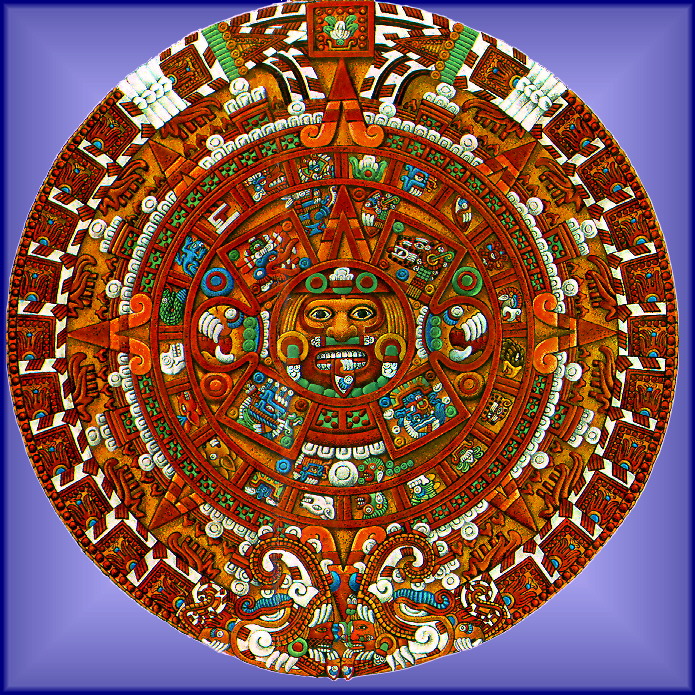
A colored rendition of the Sun Stone, or the Stone of Axayacatl. Depicts the 20 daysigns around the Sun God.
The tonalpohualli, or day-count, has been called a sacred calendar because its main purpose is that of a divinatory tool.
It divides the days and rituals between the gods. For the Aztec mind this is extremely important.
Without it the world would soon come to an end.
According to Aztec cosmology, the universe is in a very delicate equilibrium.
Opposing divine forces are competing for power.
This equilibrium is in constant danger of being disrupted by shifting powers of the gods, of the elemental forces that influence our lives.
This struggle cannot be won by any god.
The notion that everything ultimately consists of two opposing forces is essential to the Aztec worldview.
The world is always on the brink of going under in a spiritual war, a war of gods competing for supreme power.
To prevent this from happening, the gods have been given their own space, their own time, their own social groups, etcetera, to rule over.
The tonalpohualli tells us how time is divided among the gods.
The system of the tonalpohualli
The system of the tonalpohualli can be best understood by imagining two wheels that are connected to each other. One wheel has the numbers "one" to "thirteen" written on it. The second wheel has twenty symbols on it. In the initial situation, number "one" combines with the first symbol. This is the first day of the tonalpohualli. Now the wheels start moving and number "two" combines with the second glyph. This is the second day. After fourteen days, an Aztec week (trecena in Spanish) of thirteen days has passed. The wheel with the numbers shows number "one" again. The other wheel now shows the fourteenth symbol. After 260 days, the two wheels have returned to their initial position. The tonalpohualli starts all over again.
Dividing time among gods
A day (tonalli) in the tonalpohualli consists of a number and a symbol or daysign. Each daysign is dedicated to a god or elemental force, the provider of tonalli (Shadow Soul) life energy for the day. The twenty daysigns and their gods are successively:
| Nr. | Daysign | God |
|---|---|---|
| 1 | Cipactli | Tonacatecuhtli |
| 2 | Ehecatl | Quetzalcoatl |
| 3 | Calli | Tepeyollotl |
| 4 | Cuetzpalin | Huehuecoyotl |
| 5 | Coatl | Chalchihuitlicue |
| 6 | Miquiztli | Tecciztecatl |
| 7 | Mazatl | Tlaloc |
| 8 | Tochtli | Mayahuel |
| 9 | Atl | Xiuhtecuhtli |
| 10 | Itzcuintli | Mictlantecuhtli |
| Nr. | Daysign | God |
|---|---|---|
| 11 | Ozomahtli | Xochipili |
| 12 | Malinalli | Patecatl |
| 13 | Acatl | Tezcatlipoca |
| 14 | Ocelotl | Tlazolteotl |
| 15 | Cuauhtli | Xipe Totec |
| 16 | Cozcacuauhtli | Itzpapalotl |
| 17 | Ollin | Xolotl |
| 18 | Tecpatl | Chalchihuihtotolin |
| 19 | Quiahuitl | Tonatiuh |
| 20 | Xochitl | Xochiquetzal |
The nature of a day is also influenced by a force related to its number. This provides the teyollia (Spirit Soul) for the given day. The numerals with their names in Nahuatl and their related spirits are:
| Nr. | Nahuatl | God |
|---|---|---|
| 1 | Ce | Xiuhtecuhtli |
| 2 | Ome | Tlaltecuhtli |
| 3 | Yei | Chalchihuitlicue |
| 4 | Nahui | Tonatiuh |
| 5 | Mahcuilli | Tlazolteotl |
| 6 | Chicuacen | Mictlantecuhtli |
| 7 | Chicome | Centeotl |
| 8 | Chicuei | Tlaloc |
| 9 | Chicunahui | Quetzalcoatl |
| 10 | Mahtlactli | Tezcatlipoca |
| 11 | Mahtlactli-once | Chalmecatecuhtli |
| 12 | Mahtlactli-omome | Tlahuizcalpantecuhtli |
| 13 | Mahtlactli-omei | Citlalicue |
Even more, each trecena (consecutive set of days numbered from '1' to '13') has a god that rules over those days. The twenty trecenas and their associated gods or elemental forces are:
| Nr. | Trecena | God |
|---|---|---|
| 1 | Cipactli | Ometeotl |
| 2 | Ocelotl | Quetzalcoatl |
| 3 | Mazatl | Tepeyollotl |
| 4 | Xochitl | Huehuecoyotl |
| 5 | Acatl | Chalchihuitlicue |
| 6 | Miquiztli | Tonatiuh |
| 7 | Quiahuitl | Tlaloc |
| 8 | Malinalli | Mayahuel |
| 9 | Coatl | Xiuhtecuhtli |
| 10 | Tecpatl | Mictlantecuhtli |
| Nr. | Trecena | God |
|---|---|---|
| 11 | Ozomahtli | Patecatl |
| 12 | Cuetzpalin | Itzlacoliuhqui |
| 13 | Ollin | Tlazolteotl |
| 14 | Itzcuintli | Xipe Totec |
| 15 | Calli | Itzpapalotl |
| 16 | Cozcacuauhtli | Xolotl |
| 17 | Atl | Chalchihuihtotolin |
| 18 | Ehecatl | Chantico |
| 19 | Cuauhtli | Xochiquetzal |
| 20 | Tochtli | Xiuhtecuhtli |
The xiuhpohualli
The 365-day year or xihuitl consists of 18 months (meztli) of 20 days (also called veintenas) plus five extra (unlucky) days. According to Caso, the last day of the last veintena of the year gives its (tonalpohualli-) name to the xihuitl. This name is the "Xihuitl" information that is displayed by the calendar. A simple calculation learns that only four daysigns can "bear" (i.e. give their name to) the year. These are Calli, Tochtli, Acatl and Tecpatl for the Aztec calendar. A similar calculation tells us that the number of the xihuitl is raised every year. So year 1-Calli is followed by 2-Tochtli, etcetera. This means that every 52 years (4 times 13) the name of the year will be the same. A combination of 52 years is called a calendar round or xiuhmolpilli (bundle).
As claimed by H.B. Nicholson, many ethnohistorical sources suggest that not Tititl, as proposed by Caso, but Izcalli was the last veintena of the year. This shifts appears to move the year bearer to the last day of the before last veintena, which seems a rather insignificant position. However, the veintena festivals probably started at dusk while tonalli days start at dawn (or noon), so the last veintena festival actually started on the year bearer.